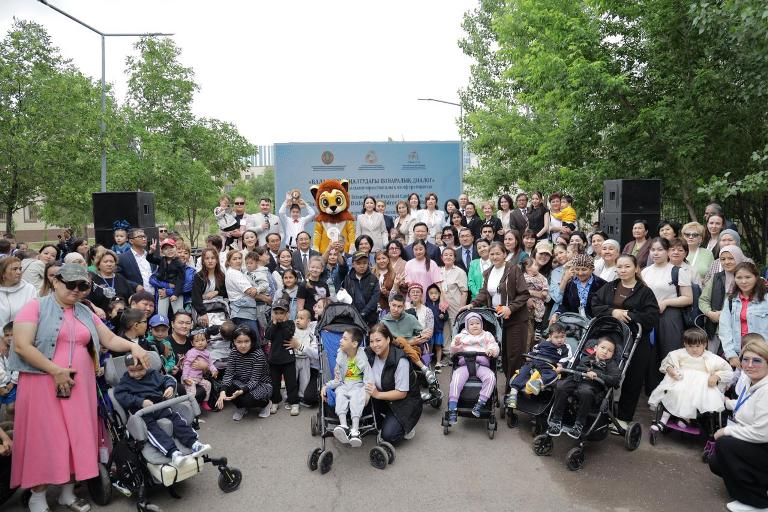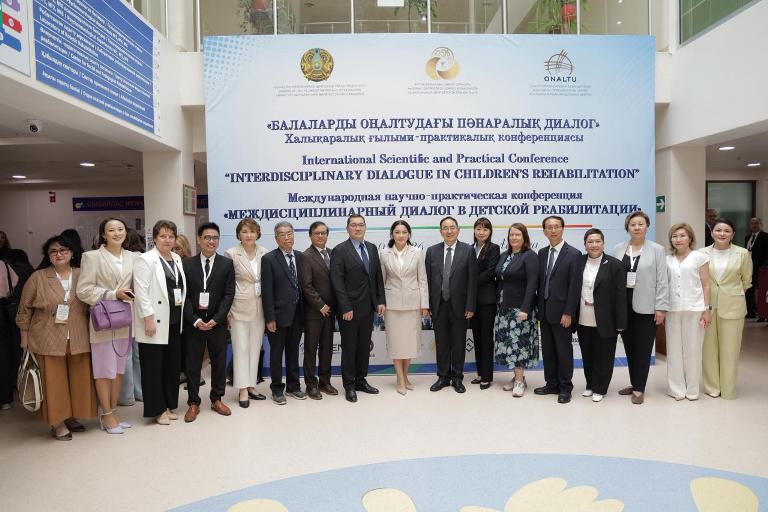


On May 28, 2026, the opening ceremony of the International Scientific and Practical Conference “Interdisciplinary Dialogue in Children’s Rehabilitation” was held at the National Center for Children’s Rehabilitation. The conference brought together leading experts, scientists, and practitioners in the field of children’s rehabilitation from Kazakhstan and abroad.
The event became an important professional platform for discussing modern approaches, innovative technologies, and interdisciplinary cooperation within the system of comprehensive rehabilitation care for children.
The conference was attended by specialists from multidisciplinary teams of healthcare organizations providing rehabilitation services regardless of ownership type, chief freelance rehabilitation specialists, pediatricians, neurologists, primary healthcare specialists, representatives of non-governmental organizations, and parent communities from all regions of the Republic of Kazakhstan.
The international significance of the conference was highlighted by the participation of speakers and experts from the People’s Republic of China, the Republic of Türkiye, the Republic of Slovenia, the Republic of Korea, the Republic of Azerbaijan, the Russian Federation, France, as well as representatives of the World Health Organization (WHO) Regional Office for Europe.
Within the framework of the conference, actual issues in the development of the children’s rehabilitation system were discussed, including:
– implementation of the WHO “Rehabilitation 2030” initiative principles;
– interdisciplinary collaboration of specialists within comprehensive rehabilitation;
– early intervention and continuity of rehabilitation care;
– introduction of robotic and digital technologies;
– evidence-based practices and innovative rehabilitation methods;
– modern approaches in physical medicine and orthotics;
– integration of medical, psychological-pedagogical, and social support for children with autism spectrum disorders;
– development of nursing practice and professional competencies of healthcare personnel.
The conference program was organized into five key sections:
- Early Intervention – Prevention of Childhood Disability;
- Robotic Technologies in Pediatric Rehabilitation;
- Modern Approaches in Physical Medicine and Orthotics;
- A Child with Special Needs in Society: An Interdisciplinary Approach to Development, Education, and Adaptation;
- The Role of Nursing Staff in the Rehabilitation Process: From Management to Implementation.
During the plenary sessions and thematic sections, participants exchanged international experience, discussed modern models of rehabilitation care, and explored prospects for implementing advanced technologies in practical healthcare.
On May 29, 11 master classes will be held on the following topics: “Early Intervention Technologies,” “Robotic Rehabilitation for Upper Limbs Using the Rebless Planar Device,” “Application of the DEWOLL-ELITE Interactive Platform in Pediatric Rehabilitation with Goniometric Control,” “Specific Features of Botulinum Therapy in Treating Various Spasticity Patterns in Children with Cerebral Palsy,” “Transcranial Magnetic Stimulation: Clinical Experience in Neurological Disorders,” “Clinical Aspects and Techniques of Serial Casting for Equinus Correction,” “Methods of Alternative Communication with Children with Autism Spectrum Disorders,” “Application of Sensorimotor Integration with Elements of Adaptive Physical Education,” “Postural Management Practice: Positioning from Assessment to Outcome,” “Organization of the Rehabilitation Process at the National Center for Children’s Rehabilitation by Advanced Practice Nurses,” “Diagnosis and Treatment of Intellectual Developmental Delay in Traditional Chinese Medicine,” and “Treatment of Cerebral Palsy in Traditional Chinese Medicine.”
The conference confirmed Kazakhstan’s strong potential in developing a modern pediatric rehabilitation system, as well as the importance of international cooperation, professional dialogue, and the consolidation of efforts among specialists from various fields to improve the quality of life of children and their families.